There isn’t just one change model. There are a lot of them—Kotter, ADKAR, Lewin, Bridges’ Transition Model, McKinsey 7‑S, and more. And what I see, over and over, is smart corporate leaders using whatever model they happen to remember from a training course… whether or not it actually fits the change they’re trying to lead.
That matters, because each model is built for a completely different kind of organizational work:
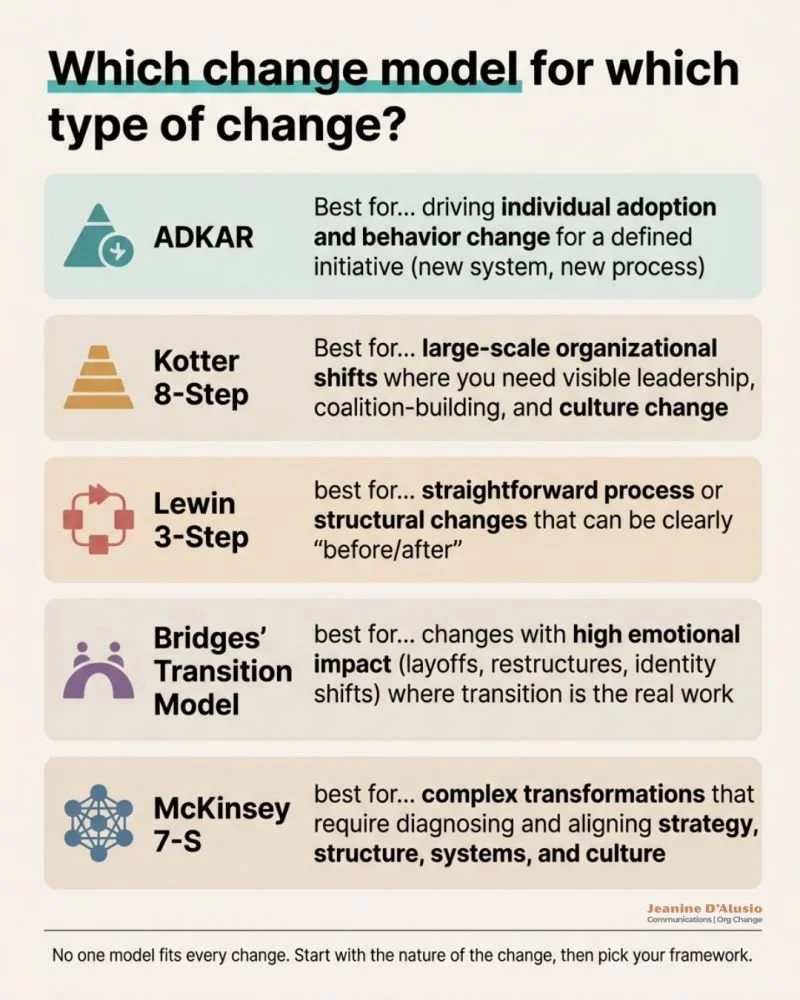
ADKAR is great when the real challenge is individual behavior and adoption: getting employees to understand, want, and do something new in their day‑to‑day work.
Kotter’s 8 Steps shine when you’re trying to drive a massive organizational shift that requires visible executive sponsorship, a guiding coalition, and long-term cultural reinforcement.
Lewin’s 3-Step Model (unfreeze–change–refreeze) is helpful for simpler, bounded structural changes where you can clearly define a stark "before and after" state and lock it in.
Bridges’ Transition Model is invaluable when the psychological and emotional side of change is the hardest part—such as corporate endings, structural restructures, and layoffs.
McKinsey 7-S is an advanced diagnostic framework rather than a step‑by‑step recipe; it helps leadership map out whether strategy, structure, systems, and culture are actually aligned before pulling any major operational levers.
In other words: change management isn’t one isolated concept. It’s a toolbox. The skill is knowing which tool to grab for which situation—and, just as important, when to combine them. Sometimes you don’t pick just one model; you layer them.
A common enterprise example is pairing Kotter with ADKAR on a large-scale transformation. Kotter gives you the macro scaffolding for the organizational shift—establishing urgency, aligning a guiding coalition, and driving cultural reinforcement. ADKAR sits underneath that macro framework, making sure individual people move through awareness, desire, knowledge, ability, and reinforcement in a structured way.
You might use Kotter to shape the overall change narrative and leadership behaviors for a global system rollout, while simultaneously using ADKAR to design how managers, frontline employees, and support teams each get ready, learn, practice, and stick with the new workflow. That’s how change management moves from a passive deck presentation to actually shifting how work gets done.
If you’ve ever been handed a complex transformation and were simply told “we’ll just use ADKAR” or “we’re doing Kotter,” you understand the structural disconnect that occurs if no one stops to ask what kind of change the organization is truly facing beforehand.
"Change management" shouldn't be treated like corporate magic. It should be treated like deliberate design.
Originally published on LinkedIn. Read the comments and join the conversation here: https://lnkd.in/p/eVMc9e-R